#41. Spaces For Foodies → Strategy Used by Eataly®
Listen to the customer retention strategy used by Eataly®.
You’ve probably heard of Eataly, the Italian marketplace founded in Italy in 2007.
Listen to host André Brathwaite share the backstory of how founder Oscar Farinetti turned his passion into a lasting brand that uses a customer retention strategy: Hobby-driven experiences, including locations (Eataly Stores in multiple cities) and activities (events, cooking classes, and market tours in Italy and other global cities).
The opinions expressed are solely those of Forms of Recreation and do not necessarily reflect the views of any brand mentioned. We encourage you to check their corresponding websites for further information.
-
Episode 41
Experiences For Foodies → Strategy Used by Eataly®
____
Most food retailers compete on convenience.
More products.
Lower prices.
Faster checkout.Eataly took a different path.
They slowed people down.
Instead of treating food as something to grab and go,
they treated eating as something to sit and savor,something to lean into,
something to learn from.They didn’t reward people for buying more.
They gave them reasons
to understand more.And that decision didn’t just pull customers in.
It built retention.
Because if Eataly had optimized for speed,
they would’ve become a typical grocery store—
visited out of necessity,
not intention.Instead, they gave people something worth returning to:
the joy of eating.OPENING REFLECTION — HOBBY AS RECREATION (2 minutes)
Picture a long table.
Flour on your hands.
Ingredients laid out—
not for efficiency,
but to keep you present.You dice fresh San Marzano tomatoes
You boil the Pappardelle pasta
This is just the beginning
as you prepare your Ragu alla Bolognese
You taste as you go.
Does it need more salt?
How’s the texture?
Should you turn up the heat?Cooking asks for your attention.
Eating what has been cooked
brings out your curiosity.
You notice differences—
between regions,
between ingredients,
between techniques.Why does this tomato taste sweeter?
Why does this pasta hold sauce better?You start asking better questions.
This isn’t consumption.
It’s participation.
And once you learn how to eat this way,
you don’t go back
to just feeding yourself.You seek better ingredients.
Better preparation.
Better understanding.You return—
not because you’re hungry,
but because you’re curious.That belief—
that food is something you enjoy, not just consume—is exactly how Eataly was built.
____
Oscar Farinetti was born in 1954.
He grew up in a town named Alba,
found in a region of Italy known for its gastronomy—
wine, truffles, and agriculture: Piemonte.The Farinetti family had a long history
of making pasta.Even the surname traces back
to the Italian word for flour.His father, Paolo,
expanded the family pasta business
into a grocery store.Then added a pasta factory.
Followed by a coffee roasting workshop.
Oscar didn’t hear about his dad’s business.
He grew up inside it.
Ingredients.
Production.
Customers.All in one place.
Until his dad did an unusual yet successful pivot.
He opened a warehouse for clothing and linens,
which made a gradual shift towards household appliances,
far removed from pasta making.
Oscar helped transform it into one of Italy's largest electronics retailers.
And then, he sold it.
Most would stop there.
He didn’t.
He went looking again.
Not for another category.
For a better question.
Food in Italy—
arguably one of the richest culinary cultures in the world—was being reduced
to convenience.Supermarkets were growing.
But knowledge was shrinking.
He was looking to return to his roots.
His family’s legacy.
Around this time,
he became involved in theSlow Food movement,
founded by his friendCarlo Petrini.
The philosophy was clear:
Protect local producers.
Preserve biodiversity.
Respect how food is made.It was a counter-position
to industrial food.Before launching anything,
he traveled across all 20 regions of Italy.To find producers.
Small ones,
Who cared about their craft.
People who knew their product.
What he saw was the gap.
So in 2007,
he opened the first Eataly
in Turin.Not a supermarket.
Not a restaurant.
A place where food could be:
Bought.
Eaten.
And learned.He didn’t build it
to sell more food.He built it
for people to experience the joy of Italian gastronomy.____
Here’s what most food retailers miss.
If the act of enjoying food is the hobby,
you need places
that supports what hobbyists practice.Eataly built them.
Start with the stores.
Eataly stores
These aren’t optimized for speed.
They’re designed for exploration.
You walk through regions and sections.
Pasta.
Cheese.
Wine.Each section tells a story.
You don’t just grab products.
You learn context in a marketplace setting.
Then comes
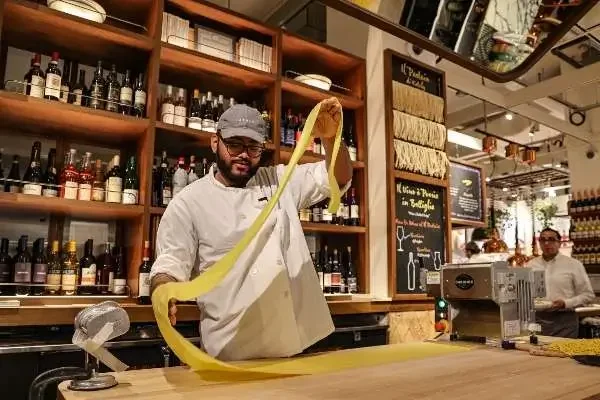
La Scuola di Eataly.Cooking classes.
Hands-on.
You don’t watch.
You participate.
You make pasta.
You taste wine.
You understand pairings.And then the events:
– Wine tastings
– Chef-led dinners
– Market tours
– Ingredient deep divesThis is where the strategy locks in.
Eataly doesn’t rely on hunger.
Hunger is temporary.
They rely on curiosity.
Curiosity compounds.
Because once someone learns:
– Why one olive oil tastes different from another
– How pasta should be cooked
– What makes a wine pair correctlyThey can’t unlearn it.
They return to improve.
That creates the loop:
Learn how to taste.
Experience quality.
Understand differences.
Return to refine.
Most grocery stores sell ingredients.
Eataly nurtures foodies.
____
Here’s the choice Eataly made
that most food brands avoid.They built a business
with the conviction that customers
want to learn.They didn’t simplify food
to move faster.They made it more complex
to go deeper.Most retailers train customers
to shop quickly.Eataly trains them
to eat intentionally.And once someone learns gastronomy,
they don’t drift easily.
Because people don’t return to products.
They return to identities.
You can sell convenience.
Or you can cultivate taste.
One creates transactions.
The other creates customer retention.
____
If loyalty disappears when convenience wins,
it was never loyalty.Give customers a reason to return:
hobby-driven experiences that make people feel alive.
Explore more
Globally admired brands are extending beyond the products they make. We at Forms of Recreation help discover handpicked spaces designed for refined hobbyists like you.