#64. Andre’s Notes → Fujifilm® House of Photography
Listen.
You’ve probably heard of Fujifilm, a camera and film manufacturer founded in Japan in 1934.
Listen to André Brathwaite, podcast host of Inside Spaces by Forms of Recreation, share his notes on a space for photographers to step into and go beyond the products Fujifilm makes.
The opinions expressed are solely those of Forms of Recreation and do not necessarily reflect the views of any brand mentioned. We encourage you to check their corresponding websites for further information.
-
Episode #64
Andre’s Notes → Fujifilm® House of Photography
____
Think about the last photo you took that actually mattered to you. Not a screenshot, not a selfie with a beach destination in the background as you try to make a friend back at home jealous — a real photo. Something you looked at and thought, I want to remember this exactly like this.
Here's my question for this week: is a camera just a tool, or is it something closer to an instrument? Observe a person who enjoys playing the violin. Over time, any violin doesn't cut it. They want the one that feels right in their hands.
So, what happens when a Japanese company watches everyone else make film and cameras abroad, decides to make their own — and then actually survives an entire industry going from analog to digital? Today, you can step into a space built for exactly that story. And it's built for anyone who's into photography.
____
Welcome back to Inside Spaces — a podcast by Forms of Recreation — where I search for "wait, this exists?" spaces, built by brands that extend beyond the products they make, for people who take their hobbies seriously.
I don't hop on a plane and walk into any of these spaces. I do exactly what you'd do — I go digging online, through photos, articles, videos, and brand pages — and I share what I find as voice notes, so you can decide whether it's worth stepping into yourself.
This week: Fujifilm, and their House of Photography in London, England.
____
Here's a founding story and a life lesson wrapped into one. Fujifilm started in Japan in 1934, as Fuji Photo Film Co., Ltd. — a spin-off of a chemical company that noticed the world was importing all of its photographic film from Europe and the U.S., and figured, why not make it themselves.
[VOICE NOTE — lo-fi filter] "Okay, this is interesting — the name 'Fuji' was actually already registered by someone else when the company wanted it, inspired by the beautiful Mount Fuji they had nearby. So, they just bought the rights off that other company. For eight thousand yen. In 1934? Just to get the name they wanted? Back then, with that kind of money, you could have bought a private villa, a few cars at the front, and named your dog Fuji for free." [END VOICE NOTE]
They didn't even start making cameras until 1948. Before that, it was purely film, photosensitive chemicals, and photographic paper. Fujifilm and its biggest rival, a certain yellow-and-red company from the United States that starts with a K and ends with a K, dominated the global film market between them.
Then digital photography happened.
Wait.
This is the part that I read that surprised me.
An electrical engineer at Kodak, Steven Sasson, invented the digital camera back in 1975. When Sasson showed company executives, they considered it "cute" but dismissed it because it lacked film. Later, Kodak invested billions in it. They were even the number one digital camera brand in the U.S. at one point. But they couldn't stop protecting their golden goose, film. Kodak’s business model relied on selling cameras and making their money on the people repeatedly buying film and chemicals. The problem? Digital cameras eliminated the need for film, killing their golden goose. They filed for bankruptcy in 2012.
[VOICE NOTE — lo-fi filter] "Hold on — Kodak didn't miss the boat. They built their own coffin. They just couldn't let go of protecting the film business long enough to actually become a digital company. It's not a story about a company failing to see the future. It's a story about a company seeing it clearly and still not being able to change. Sounds like a life lesson for all of us… professionally and personally." [END VOICE NOTE]
Fujifilm's CEO at the time, Shigetaka Komori, made a decision that sounds obvious in hindsight but was considered extreme at the time: he had the company audit every single technology they owned, and asked, where else could this apply if analog photography disappeared entirely. They found over seventy transferable technologies buried inside their film company. In film and camera production, a company has research on collagen, anti-oxidation, optics, among others. This is what helped them build new products. By diversifying outside the film and camera industry, they survived the winter. Kodak, meanwhile, kept trying to protect its existing film revenue — even selling off its profitable healthcare imaging division, right as demand for medical imaging was increasing, just so they could keep feeding its dying golden goose.
[VOICE NOTE — lo-fi filter] "This is a great note to save. So good, it almost sounds made up. Fujifilm makes anti-aging skincare. Actual skincare, sold in stores, it's called Astalift, and it exists because they spent decades researching how to stop color photos from fading in sunlight. It turns out that's basically the same science as stopping skin from aging in sunlight. A camera company is also on your bathroom counter. Crazy!" [END VOICE NOTE]
That instinct — take what we actually know, and go find every place else it applies, even if it means shrinking the business you started with — is what helped Fujifilm survive while still keeping their photography roots. And that's why the Fujifilm House of Photography is worth stepping into.
____
Okay. It's time to see with your mind's eye.
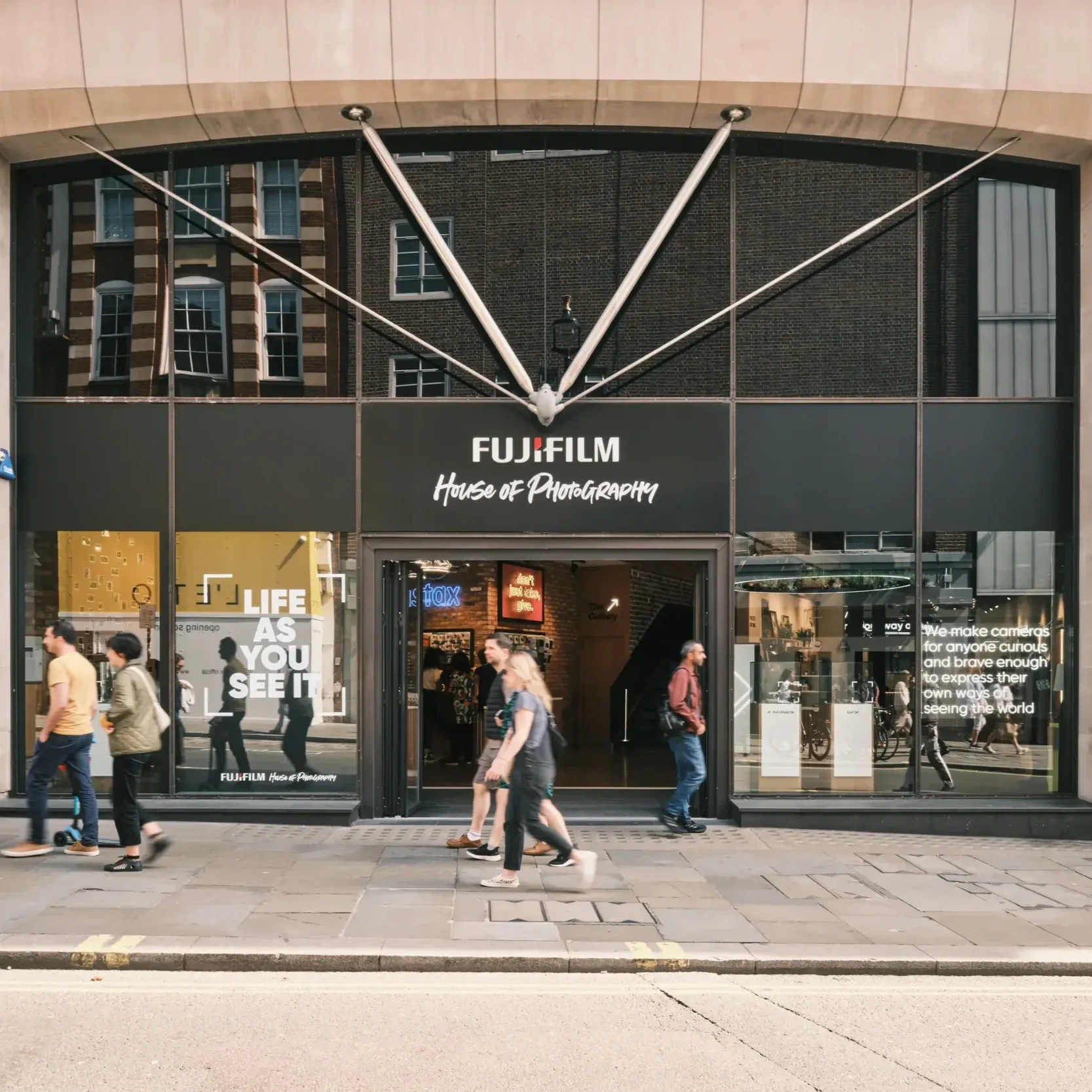
You are walking along the streets of Covent Garden in London. It's cold, and you could really use a warm cup of coffee right about now. Tucked between the theaters and the market stalls, you see something you didn't even know existed — the flagship Fujifilm House of Photography. Three floors, over 700 square meters, and that "get me a coffee" frown just got turned upside down.
Walking in, you're not only stepping into a place that sells cameras and film. A gallery and exhibition space is running actual professional photography shows in one corner. A dedicated instant-photography playground for Instax shooters in another. And an entire specialist area just for their GFX medium-format system — the cameras serious photographers dream about.
You can genuinely play here. Pick up an X Series body and try it under real lighting conditions. A station where you can take headshots and portrait photos. Community events you can join like "Coffee with Fujifilm", and workshops you can take part in like "Wildlife On Your Doorstep Photography".
[VOICE NOTE — lo-fi filter] "Small detail to remember — there's a basement studio downstairs, fully rigged with professional lighting, and you can actually book time in it. Not to buy anything. Just to go practice." [END VOICE NOTE]
____
So — you're the person who has opinions about film simulations, who knows the difference between a rangefinder and an SLR, and who's genuinely curious whether medium format is worth the hype. What's actually there for you?
Beyond browsing and testing gear, there's an entire program called Fujifilm School — actual courses, from beginner to intermediate, taught in-house. There are photography walks led by real Fujifilm X-Photographers, out shooting the city together rather than sitting in a classroom. There are masterclasses on specific skills, like lighting and macro photography. And there's an actual photography studio you can book entirely for your own shoots.
[VOICE NOTE — lo-fi filter] "What would I join if I were into photography? The community photo walks. Think about it. You are in London, and you've a group of people you may hang out with after the walk, an expert Fujifilm guide, and a camera that is free for you to use during the walk. It's like you are on a city safari. You head towards Trafalgar Square, taking pictures of old buildings, new buildings, and people in their habitat. Yes, you have to deal with the drabby weather and honking, but that just adds to the experience." [END VOICE NOTE]
____
And that's really the thread of this whole episode. Fujifilm didn't need to build a three-floor experience center in London. They survived the death of an entire industry once already — they could have just kept selling cameras online as well as continue diversifying their business and called it a day.
Instead, they built a space that says, however you got into photography, whatever camera is actually in your bag, come play with the tools, come learn to use it, and come learn with others. That's a company that understands the difference between selling a product and supporting a hobby.
That's the whole reason behind Inside Spaces, honestly. Brands that build something worth stepping into — and let this be the first step in getting you there.
____
Alright — if you've been to a Fujifilm House of Photography, taken one of their courses, or you've got a go-to camera you'd never trade for anything else, I want to hear about it.
No need to go as detailed as I did. Just tell me what you see, through a voice note. It's easy.
There's a WhatsApp link in the show notes, or visit formsofrecreation.com. Just send me a voice note describing what it was actually like for a hobbyist like you. It might make it into a future episode.
Tune in next week on Inside Spaces by Forms of Recreation, for a new space that inspires you to step in.
Explore more
Globally admired brands are extending beyond the products they make. We at Forms of Recreation help discover handpicked spaces designed for refined hobbyists like you.