#65. Andre’s Research Notes → Yonex® Center, Belgium
Listen.
You’ve probably heard of Yonex, a badminton racket manufacturer founded in Japan in 1946.
Listen to André Brathwaite, podcast host of Inside Spaces by Forms of Recreation, share his notes on a space for badminton players to step into and go beyond the products Yonex makes.
The opinions expressed are solely those of Forms of Recreation and do not necessarily reflect the views of any brand mentioned. We encourage you to check their corresponding websites for further information.
-
Episode #65
Andre’s Notes → Yonex® Center, Belgium
____
Think about the last time you played something purely for the joy of it. Not to prove anything, just because. My last time? Picking up a racket, moving my body around a court, and hitting a cork with a few glued feathers left me smiling for days.
Here's my question for the week: how much does the space you play in change how much you actually enjoy the game? A badminton court is just a badminton court, right?
So, what happens when the company that makes the racket in your hand also builds the room you're standing in?
____
Welcome back to Inside Spaces — a podcast by Forms of Recreation — where I search for "wait, this exists?" spaces, built by brands that extend beyond the products they make, for people who take their hobbies seriously.
I don't hop on a plane and walk into any of these spaces. I do exactly what you'd do — I go digging online, through photos, articles, videos, and brand pages — and I share what I find as voice notes, so you can decide whether it's worth stepping into yourself.
This week: the Yonex Center, in Belgium.
[WHO IS YONEX]
Okay, this part of my notes comes from the archives. An episode I recorded back in 2025 on the founding story of Yonex. Let's take a listen:
The story of Yonex does not begin with badminton.
It begins with a promise.In the 1940’s, before Minoru Yoneyama ever shaped a badminton racquet,
he was a young man in World War II,
assigned to a suicide unit in the Imperial Japanese Army —
ordered to sail explosive-filled boats
into American ships.But before any mission could be carried out,
he was captured.And in the quiet, uncertain days that followed as a prisoner,
Minoru made himself a vow:If he made it out alive,
he would spend the rest of his life
creating things that contributed to peace —
not violence.When he returned home after the war,
he had almost nothing
except for a single woodworking motor left behind by his late father, who had inherited it from the former wooden sandal factory where he once worked.With that single motor, Minoru began carving wooden corks for sake bottles
and later, wooden floats for fishing nets —
a trade that demanded precision, consistency, and care.
It wasn’t glamorous, but it was his craft.
And Minoru cared about craft more than anything.Then the world shifted.
Plastic floats emerged and replaced wood overnight,
toppling the business he had built.Most people would have accepted defeat.
Minoru made a different promise:He would never again be left behind by technology.
That vow became the philosophy that still guides Yonex today.
So he asked himself a simple question:
"I am a craftsman. What else can I make?"That question pulled him toward a new craft —
one that required the same balance, precision, and sensitivity he’d mastered:
badminton racquets.By the 1950s, Minoru and a small team were shaping wooden racquets by hand,
experimenting with weight, tension, and frame design.
Every racquet was a study in possibility.Then in 1963, disaster struck again:
a fire consumed the company’s main factory.But Minoru didn’t surrender.
He and his team rebuilt a new production plant
in just three days —
a declaration of grit.As the company grew, Minoru chose a new name:
Yonex — a blend of Yoneyama and the letter X,
symbolizing infinite potential.And while other brands moved production overseas,
Minoru kept Yonex rooted in Japan.
He remained loyal to monozukuri —
the Japanese philosophy of making things with soul, discipline,
and respect for craft.That choice shaped the brand’s identity
and set the gold standard for quality players still feel today.Through aluminum, through graphite, through every breakthrough that followed,
you can trace each innovation back to Minoru’s vow:
never be left behind by technology,
and never stop crafting with intention.When Minoru Yoneyama passed away in 2019 at age 95,
he left behind more than a company.
He left behind a global movement in badminton —
one built on courage, reinvention, and a promise to begin again.____
Okay, it’s time to use your mind's eye.
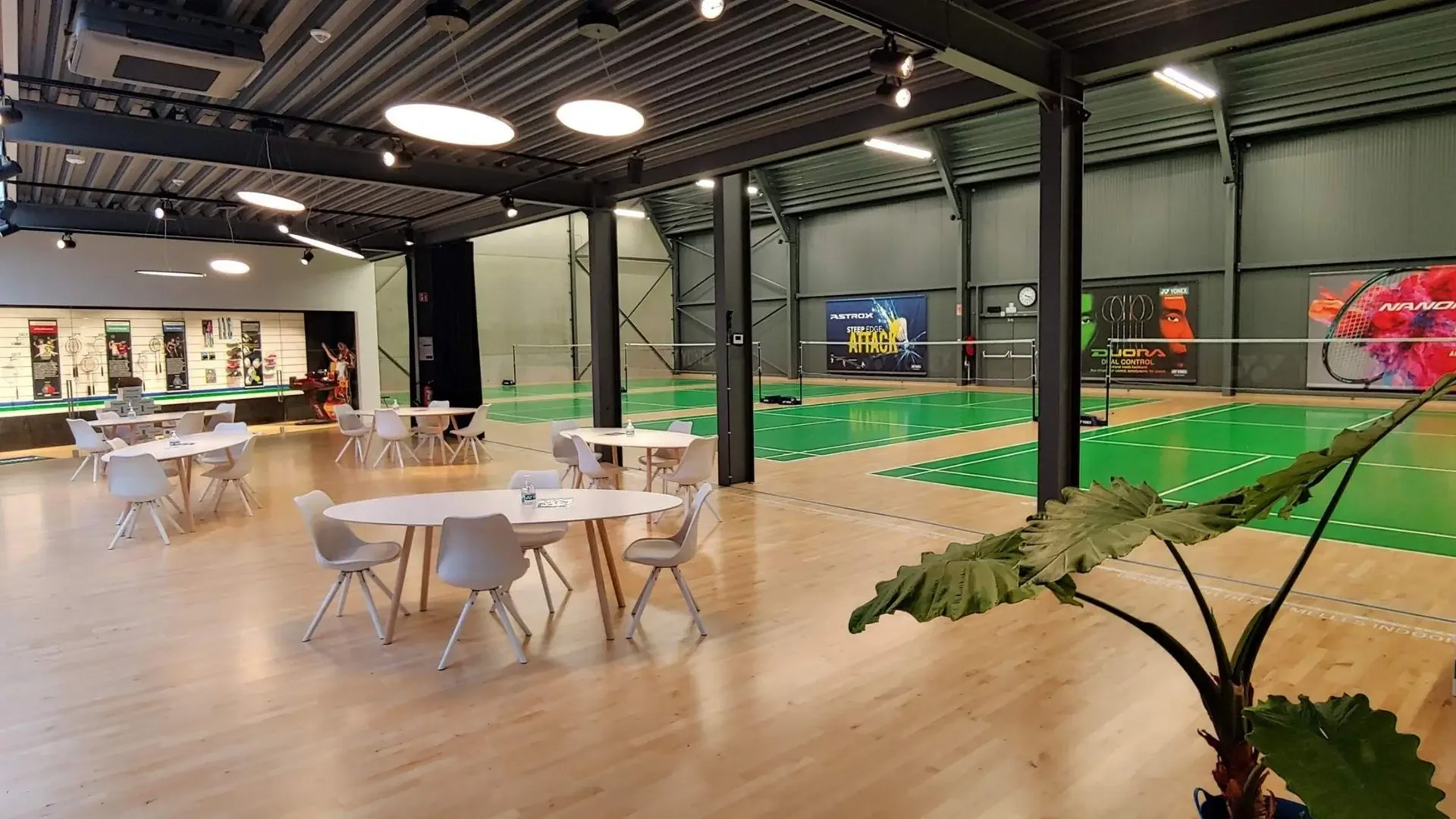
You're in Aartselaar, Belgium, walking into a building purpose-built around one single sport. Not one large space, about 200 court lines painted in different colors to accommodate multiple sports, as you try to figure out which one you will be using to play.
Five exclusive courts, one single sport. Badminton.
The space? Ten meters high. The floor? A shock-absorbing wood surface, built specifically to protect players' joints during quick lateral movements. Humidity is kept constant, since badminton shuttles are sensitive to air conditions. Even the lighting is badminton-specific, so you can actually track a shuttle moving at high speed without losing it against a glare.
[VOICE NOTE — lo-fi filter]
"Ahhh, humidity control. For most of us, badminton has been played in a random gym where the shuttle either flies weirdly or suddenly drops depending on the weather that day. I would never have thought of humidity. Now I have a better excuse to share as to why I missed a shot."
[END VOICE NOTE]And the whole building runs on solar panels and heat exchangers for the underfloor heating. Even the environmental footprint of the building was thought of.
____
So, you're someone who actually plays. You know the difference between a smash and a drop, you've got a preferred string tension, and you have real opinions about feather shuttles versus synthetic ones. What's here for you?
As I browse through their website, it says the courts are bookable 24/7, which tells you this was even built for people who get that urge to play at 3 am. There's personal training available too, with a list of dedicated coaches you can book directly for one-on-one sessions to sharpen a specific part of your game.
And then there's the "Yonex Experience" — this is where it gets really fun. Badminton clubs, usually twenty-five to thirty-five players at a time, come through for a structured session where half the group gets a professional walkthrough of the newest rackets, shoes, and shuttles, while the other half is out on court actually testing that same gear live, all under a trainer's eye. Then they swap. So you're not just told a new racket is lighter or has a bigger sweet spot — you're out there in the same building, hitting with it immediately.
[VOICE NOTE — lo-fi filter]
"This is such a smart idea. Instead of a brand representative just talking at you about a new racket, you literally get to practice with it on a real court. Not an ad you watched, or a glass case separating you from the gear. That gap between hearing about something and trying it is basically zero here."
[END VOICE NOTE]By the looks of it, there is also a bar to hang out at before or after the game to enjoy a drink, or what I like to call “Beverages with percentages”. The bar is open from Monday to Thursday, yet what is most interesting is that it is not staffed. You can take whatever you want - beer, wine, you name it - and you are trusted to pay the amount due. On its website it says, “We count on everyone's care and honesty.” You don’t see that every day. And if need be, there is also a meeting room, which seems to be pretty close to where you can get a drink.
____
And that's really the thread of this whole episode. Yonex didn't need to build a five-court badminton hall in Belgium. They already had the global racket business, the Olympic supplier contract, the pro sponsorships. The equipment alone would have kept the brand relevant forever.
Instead, they became a retail brand that decided to extend beyond what they sell. A space that you can step into — humidity-controlled, perfectly lit, and even open at 3 am if that's when you want to play.
That's the whole reason behind Inside Spaces, honestly. Brands that build experiences worth stepping into — and let this be the first step in getting you there.
____
Alright — if you've played at the Yonex Center, joined a Yonex Experience with your club, or you've got a racket in your bag you'd never trade, I want to hear about it.
No need to go as detailed as I did. Just tell me what you see, through a voice note. It's easy.
There's a WhatsApp link in the show notes, or visit formsofrecreation.com. Just send me a voice note describing what it was actually like for a hobbyist like you. It might make it into a future episode.
Tune in next week on Inside Spaces by Forms of Recreation, for a new space that inspires you to step in.
Explore more
Globally admired brands are extending beyond the products they make. We at Forms of Recreation help discover handpicked spaces designed for refined hobbyists like you.