
#62. Andre’s Research Notes → House of Angostura®
Listen to Andre’s notes.
You’ve probably heard of Angostura, a rum distiller and aromatic bitters brand founded in Venezuela in 1824 and relocated to Trinidad and Tobago in 1875.
Listen to André Brathwaite, podcast host of Inside Spaces by Forms of Recreation, share his notes on a space for cocktail-making enthusiasts to step into and go beyond the products Angostura makes.
The opinions expressed are solely those of Forms of Recreation and do not necessarily reflect the views of any brand mentioned. We encourage you to check their corresponding websites for further information.
-
Episode #62
Andre’s Notes → House of Angostura®
____
Think about a bar you walked into recently. You might have asked for a cocktail, and noticed that the bartender dashed a few drops of something most people don’t even know what it is.
Here's my question for today: how much of what makes a drink great comes down to the one ingredient most people don’t pay attention to?
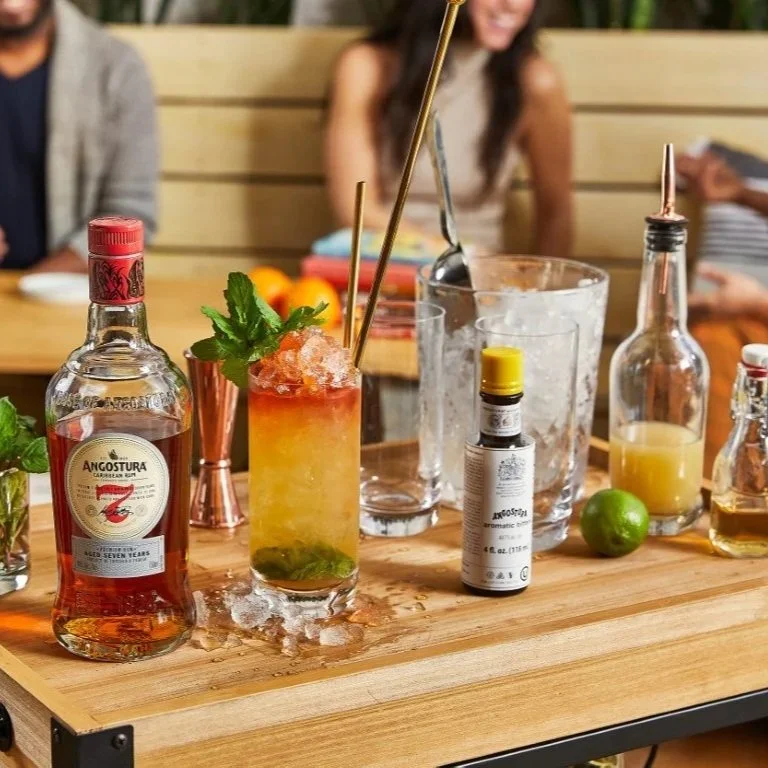
Because there's a little brown bottle with a yellow cap and an oversized paper label, sitting behind almost every bar in the world. Yes, Angostura bitters. What started its life as a medicine for soldiers on the battlefield somehow ended up being the thing that makes your Old Fashioned taste like an… Old Fashioned.
____
Welcome back to Inside Spaces — a podcast by Forms of Recreation — where I search for "wait, this exists?" spaces, built by brands that extend beyond the products they make, for people who take their hobbies seriously.
I don't hop on a plane and walk into any of these spaces. I do exactly what you'd do — I go digging online, through photos, articles, videos, and brand pages — and I share what I find as voice notes, so you can decide whether it's worth stepping into yourself.
This week: the House of Angostura, in Laventille, Trinidad.
____
Okay, this history of Angostura is genuinely one of the most impressive I've come across.
Angostura bitters was invented by a German doctor named Johann Siegert. He treated soldiers and fought in the Napoleonic Wars, including Waterloo, then left Europe to join Simón Bolívar's revolutionary army, fighting for independence from Spain. Simón Bolívar made him Surgeon General of a military hospital in a river town called Angostura — today known as Ciudad Bolívar in Venezuela. And that's where, in 1824, after four years of trial and error with tropical herbs and plants, Dr. Siegert perfected a very bitter tonic meant to treat soldiers' stomach pains and deadly fevers.
[VOICE NOTE — lo-fi filter]
" I did not expect a bottle of bitters to have a war-hero origin story. This guy fought at Waterloo, then went and helped Simón Bolívar liberate a continent, and somewhere in the middle also invented one of the most important ingredients in cocktail history. Now that's a résumé."
[END VOICE NOTE]So, how does medicine end up in a martini glass? Reading up on the history, I found out that the town of Angostura sat on a major shipping route on the Orinoco River in Venezuela, and international sailors passing through picked up bottles for seasickness and stomach trouble. Among them, British sailors famously carried it onto their ships, started adding a few dashes of bitters with their gin to cut the harshness of the medicine found onboard, and called it Pink Gin. The word spread, and the British had, quite by accident, created one of the most famous gin cocktails in history. What started as a cure became a mixer, and Dr. Siegert leaned in by selling it commercially. By 1850, he'd resigned from the army entirely to focus on producing the aromatic bitters full-time, because the brand he called Amargo Aromático was thriving.
After Dr. Siegert died in 1870, his three sons took over: Carlos, Alfredo, and Luis. Soon after, political unrest in Venezuela pushed them to relocate the whole operation to Trinidad and Tobago, building out a new factory in the 1870s and naming the bitters Angostura. While the product was conceived by a German and its Venezuelan by birth, the brand we speak of today is Trinidadian.
That's when the brand's most famous, most accidental detail happened.
[VOICE NOTE — lo-fi filter]
"I have to tell this story properly. The Siegert brothers were preparing to enter a competition. One brother designed a new bottle. Another brother designed a new label. Nobody checked in with the other. The paper label came back too big for the bottle. It stood way too tall, and it was too late to fix before the deadline, so they just shipped it as-is, oversized label sticking out past the neck of the bottle. They didn't even win the competition — but a judge pulled them aside and told them to keep the mismatched label anyway, because it made the bottle impossible to miss on a shelf."
[END VOICE NOTE]The miscommunication between two brothers that's been sitting on every bottle, made in the town of Laventille, Trinidad, for over 150 years.
____
Okay — mind's eye time.
You're standing at the corner of Eastern Main Road and Trinity Avenue in Laventille, at the House of Angostura. You step in. The tour starts at the Angostura Museum, which sets the scene with Siegert's story before moving into the working parts of the facility — a look at the cooperage, where barrels are still built the old way, and the bottling plant, all state-of-the-art. This is where you learn that Angostura is also a rum distillery.
Then comes the part everyone actually shows up for: a glimpse into the Bitters Room. It's the only place in the entire world this product is made, and the secrecy around it is real. No photography allowed, at all. Above the room, a small group of people — reportedly only five in the world — know the full formula. They measure and crush the ingredients themselves, before sending them down a chute into blending vats below, steeped in alcohol exactly the way Dr. Siegert did it two centuries ago.
[VOICE NOTE — lo-fi filter]
"What a great fact — only five people on Earth know the actual recipe, and all of them have agreed to keep it that way. No bribes? No drunken nights to siphon out information? No threats to their family? Two hundred years, and it's never leaked. Also, In an era where everything gets figured out and reverse-engineered, that’s pretty impressive."
[END VOICE NOTE]The tour wraps up with a tasting, guided by Angostura's own master distiller — and there's also a Butterfly Collection and Angostura Art Collection on-site, which is an odd yet beautiful thing to stumble into.
____
So — you're the person who enjoys making cocktails. You know the difference between a dash and a splash, and you have opinions about whether an Old Fashioned needs orange peel or not. What's actually here for you?
Beyond the standard tour, there's a Premium Angostura Experience — a deeper, behind-the-scenes version with expertly crafted cocktails and bitters-infused food pairings, made specifically to walk you through the stories that shaped the brand. This is where you go if the regular tour leaves you wanting more.
And here's the number that puts everything in perspective: Angostura is exported to roughly 170 countries and, by the company's own account, holds around 85% of the world bitters market. That means the odds that the bar closest to you right now — any bar, anywhere — has a bottle of this exact thing sitting behind it are extremely high.
____
And if you're the kind of enthusiast who doesn't just enjoy cocktails but actually wants to compete — that's where the Angostura Global Cocktail Challenge comes in.
It's been running since 2001, a worldwide search for Angostura's next Global Brand Ambassador. Bartenders enter regional qualifiers all over the world, and the standouts advance to a global final. Entrants are judged on more than just taste — the brand looks for a genuine, deep understanding of their whole portfolio, real technical skill, and, of course, charisma, since whoever wins ends up representing Angostura on the world stage.
The competition is explicitly built to be a real, valuable experience for any working bartender.
[VOICE NOTE — lo-fi filter]
"I read that finalists have historically been disqualified for using too few dashes of bitters, or too many ingredients. There are actual technical rules — minimum dashes, maximum ingredient count. That's how seriously this brand treats the craft. In other words, they want you to put some respect on those bitters."
[END VOICE NOTE]____
And that's really the thread of this whole episode. Angostura didn't need to open its house, run a global bartending competition, or let strangers peek into the one room in the world where the actual formula gets made.
They could've just kept selling the brown bottle with the yellow cap and oversized label. And given that it already sits behind 85% of the world's bars, nobody would have blamed them.
Instead, they turned a 200-year-old secret into something you can step into, even if you'll never be standing among the 5 people still holding a secret from the world.
That's the whole reason behind Inside Spaces, honestly. Brands that build something worth stepping into — even if, for now, the closest you get is a voice note about it.
____
Alright — if you've toured the House of Angostura, competed in the Global Cocktail Challenge, or you've just got a go-to cocktail that leans on that little oversized-label bottle, I want to hear about it.
No need to go as detailed as I did. Just tell me what you see, through a voice note. It's easy.
There's a WhatsApp link in the show notes, or visit formsofrecreation.com. Just send me a voice note describing what it was actually like for a hobbyist like you. It might make it into a future episode.
Tune in next week on Inside Spaces by Forms of Recreation, for a new space that inspires you to step in.
