#59. Andre’s Notes → National Geographic® Museum of Exploration
Listen to Andre’s notes.
You’ve probably heard of National Geographic, a magazine publication founded in the United States in 1888.
Listen to André Brathwaite, podcast host of Inside Spaces by Forms of Recreation, share his notes on a space for nature, science, and cultural enthusiasts to step into and go beyond the products National Geographic makes.
The opinions expressed are solely those of Forms of Recreation and do not necessarily reflect the views of any brand mentioned. We encourage you to check their corresponding websites for further information.
-
Episode #59
Andre’s Notes → National Geographic® Museum of Exploration
____
Think about the first time you flipped through a magazine that made you want to go somewhere you'd never been. A coral reef. A mountain range. Someone's face from a country you'd have a hard time pointing out on a map.
For a lot of us, that magazine came with a yellow border.
So here's my question for this week: when curiosity hits, when you feel that pull toward something you don't fully understand yet, do you follow it, like a white rabbit? Or do you let the page turn?
National Geographic's magazine covers are windows. You look through them, you feel something, and then you turn the page. But what if that brand takes that window and builds an entire space around it — one you can actually step into?
This episode is for nature, science, and cultural enthusiasts. And if you're not one yet, you just might get curious enough to become one.
Welcome back to Inside Spaces — a podcast by Forms of Recreation — where I search for "wait, this exists?" spaces, built by brands that extend beyond the products they make, for people who take their hobbies seriously.
I don't hop on a plane and walk into any of these spaces. I do exactly what you'd do — I go digging online, through photos, articles, videos, and brand pages — and I share what I find as voice notes, so you can decide whether it's worth stepping into yourself.
This week: National Geographic's Museum of Exploration in Washington, D.C.
You already know the product, but do you know the story. Founded in 1888, the National Geographic Society is a nonprofit that's spent well over a century funding scientists, explorers, and educators across the globe, and its yellow-bordered magazine covers are recognizable everywhere.
How about the magazine itself? It didn't even get its start until the early 1900s.
At first, it struggled, packed with dense scientific reports. But then something shifted. In 1905, the editors took a risk and ran an issue filled almost entirely with photographs of Tibet. No long essays. Just short text and images.
The rest is history.
But here's the thing. Nowadays, if you're not a magazine subscriber, you'd probably find a copy at your cool uncle's house, on the coffee table at your dentist's office, or tucked in some corner of a school library. This summer, National Geographic decided they had to go further.
[VOICE NOTE — lo-fi filter]
"Okay, quick note. National Geographic was founded by a small group of 33 explorers and scientists that included Alexander Graham Bell… you know, the inventor of the telephone. They met in Washington, D.C. with a simple goal: to increase and share geographic knowledge.”
[END VOICE NOTE]As I read what's online, the new National Geographic Museum of Exploration — they call it the MOE — is a more than 100,000-square-foot museum that opened this summer in the middle of D.C. Its mission, according to the Society's chief campus and experiences officer, is to "inspire the explorer in every visitor."
Is it just me, or are they trying to convert us? Well. It's working.
Okay. Time to use your mind's eye.
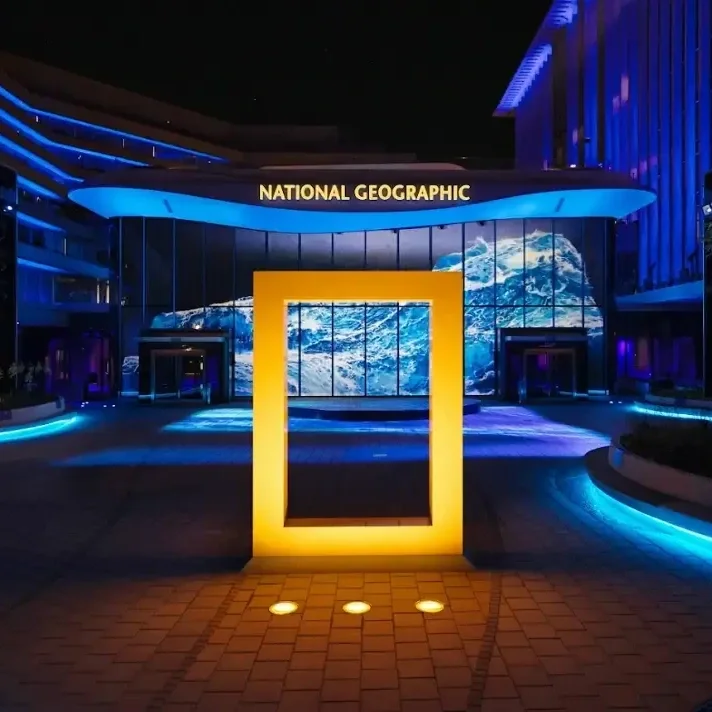
You are at the National Geographic Society's headquarters campus in downtown D.C. You walk in through the Pavilion, and the first thing you see is a large-scale media wall, with images of what you're about to experience. You can tell they've thought this through.
There's a vast photo archive worked into the galleries, towering outdoor projection screens, a 400-seat theater, and an actual collection of field gear and artifacts collected from nearly 140 years of exploration.
As you're walking through the galleries, there's a display of an actual moon rock, collected during the Apollo 12 mission in 1969. Just sitting there. You find yourself wondering if there'll ever be a hotel to visit on the moon someday.
[VOICE NOTE — lo-fi filter]
"I would go to the museum just for this. They have an Interactive Darkroom. A space where you can learn the process of producing prints using a darkroom. Not the 'I'll send them wirelessly to you and print them for me' type of learning. It's more like the 'hold my analog camera, let me take the film out and produce them myself' type of learning."
[END VOICE NOTE]There's also the Archives, a tour through National Geographic's entire history, complete with copies of every single edition of the magazine ever published, and a gallery where you can actually search through decades of photography by specific date, including the ones the day you were born. That's National Geographic pulling at your heartstrings.
So, if you're the person who's read every issue since you were a kid, or the one who still stops on a hiking trail to look at constellations, what's there for you?
I was watching a video that gave a walkthrough of their ten different exhibitions included with general admission. "Photo Ark: Animals of Earth" is one of the standouts, built around photographer Joel Sartore's mission to document every captive species before some of them disappear entirely. Then there's Rolex Explorers Landing, which traces the stories and impact of actual National Geographic Explorers across the decades.
There's also the Geoverse, a 270-degree immersive theater running rotating shows on wildlife and nature, and an outdoor nighttime experience where they project ocean imagery, sound, and interactive media onto the building's exterior windows after dark.
Your general admission ticket also gets you into the museum's daily programming, including Explorer talks and seasonal pop-up events. Keeps things nice and fresh, straight from the field.
[VOICE NOTE — lo-fi filter]
"Adding this before I forget. Apparently there's a whole after-hours thing called Nat Geo Nights. For the 21 and over, to enjoy live music, art, storytelling, cocktails, with a different theme every month. In other words: school field trips, you are not welcome here."
[END VOICE NOTE]If you don't live anywhere near D.C., that doesn't mean you can't step into what National Geographic has built.
National Geographic Live is a touring series that brings National Geographic Explorers straight to your city: actual photographers, scientists, and filmmakers stepping off the page and onto a stage, sharing field footage and stories from expeditions most of us will only ever see in a magazine. Shows typically include pre-show trivia, an hour-long stage presentation, and a live Q&A, and they run in venues across North America, not just one city.
In a recent blog, I read that there's also the National Geographic Society, a non-profit membership club you can join through donations. Depending on your membership level, you get a monthly e-newsletter with mission updates, event info, and museum updates, a printed annual calendar full of National Geographic photography, and unlimited complimentary admission to the Museum of Exploration.
And that's what the whole episode is about. National Geographic didn't need to build a museum, or run a touring speaker series, or throw a themed cocktail night. They could've just kept printing a beautiful magazine and called it a day.
Instead, they took a window you look through — a photo, a documentary, or a moon rock in an article you read once — and built around it. A space where you don't just read about exploration. You stand in it.
That's the whole reason behind Inside Spaces, honestly. Brands that build something worth stepping into, even if for now, the closest you get is my voice talking about it.
Alright — if you've been to the Museum of Exploration, caught a National Geographic Live show in your city, or you're a Society member yourself, I want to hear about it.
No need to go as detailed as I did. Just tell me what you see, through a voice note. It's easy.
There's a WhatsApp link in the show notes, or visit formsofrecreation.com. Just send me a voice note describing what it was actually like for a hobbyist like you. It might make it into a future episode.
Tune in next week on Inside Spaces by Forms of Recreation, for a new space that inspires you to step in.
Explore more
Globally admired brands are extending beyond the products they make. We at Forms of Recreation help discover handpicked spaces designed for refined hobbyists like you.